

11 - Hero Full

Does Alcohol
Have Any Business
in Business?
00 - Spacing
00 - Spacing

Is alcohol a blind spot in your organization?
Happy hours, recognition events, client dinners, networking: in today's business world, alcohol is often woven into company culture by default. But its presence can come with hidden costs, impacting productivity, workplace safety, team dynamics, and brand reputation.

A closer look at alcohol in professional settings
In professional settings, standard alcohol habits can create subtle social pressure for employees who choose not to drink, drink less, or simply want to participate differently. Rethinking these habits isn't about taking away the fun: it is about creating an inclusive, safe, and welcoming culture where everyone feels included.

Doing things differently, without losing the sense of connection
Real human connection isn't measured by what’s in your glass. By offeringattractive alcohol-free alternatives, establishing clear internal guidelines, and designing inclusive team events, you can transform your workplace culture, without sacrificing team spirit, networking, or celebration.
00 - Spacing
00 - Spacing
Éduc’alcool invites managers, HR leaders, and executives across Quebec to ask a simple question: Are your company’s drinking practices aligned with your core values, legal responsibilities, and modern workplace expectations?
00 - Spacing
00 - Spacing
3 Actionable Steps to Start the Conversation
14 - Cards
- 1 -
Audit your current culture
What role does alcohol play in your team activities, business events and internal policies?
- 2 -
Provide genuine choices
Make high-quality, alcohol-free options as visible, attractive, and valued as traditional alcoholic drinks.
- 3 -
Set clear expectations
Establish clear guidelines for conduct at corporate functions, clarify organizational liability, and always ensure safe transportation options for employees getting home.
00 - Spacing
Helpful tools
00 - Spacing

00 - Spacing
A Guide to Hosting Responsible Corporate Events
Plan events that are engaging, inclusive, and safe. Download our practical playbook to rethink alcohol at your corporate gatherings while maintaining a warm, convivial atmosphere that brings people together.
00 - Spacing
00 - Spacing
00 - Spacing
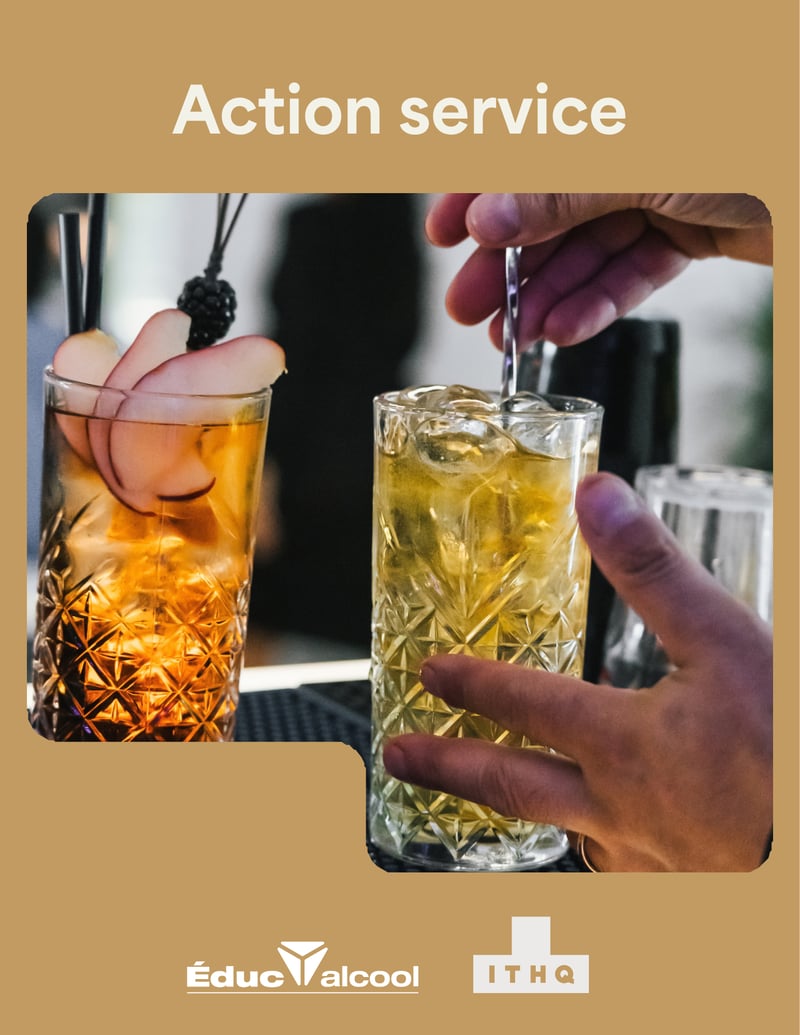
Action Service - Equip your team to mitigate risks and serve responsibly.
Offered by the Institut de tourisme et d’hôtellerie du Québec with support from Éduc’alcool, Action Service is a specialized training program for hospitality and corporate venue managers. It equips your staff to spot signs of intoxication, understand legal liability, and manage high-risk situations effectively protecting your guests, your team, and your organization.
00 - Spacing


What Data Says
39 %
of the total economic burden linked to alcohol consumption
The economic burden of alcohol on society | analysis by INSPQ
Update: Avril 23, 2026
Alcohol misuse carries a heavy price tag for society, straining healthcare systems, increasing legal risks, and weighing down business performance.
Productivity Loss: Reduced efficiency, absenteeism, and premature mortality account for 39% of the total economic burden linked to alcohol consumption.
Higher Overhead: The societal and workplace costs associated with alcohol remain proportionally higher than those of tobacco, cannabis, or other substances.
00 - Spacing
TO GO FURTHER
Research insights for healthier workplaces

The research points in the same direction: alcohol-related risks at work are shaped not only by individual choices, but also by workplace culture, leadership, social norms, and organizational support. For employers, this means prevention can be practical, evidence-informed, and integrated into broader health, safety, and well-being efforts.
00 - Spacing
Giezek et al., Frontiers in Public Health — risk factors for harmful alcohol consumption and workplace intervention strategies
Published on Jan. 4, 2026
This literature review, based on international studies published between 2020 and 2024, identifies key risk factors for harmful alcohol consumption among employees: high job strain, workplace-related stress, low social support, job insecurity, unfavourable organizational culture, and shift work. Harmful alcohol use was also associated with increased risk of workplace accidents, absenteeism, diminished productivity, and impaired occupational functioning.
For organizations, the main takeaway is that effective preventive approaches are rarely based on a single action. The review points instead to digital interventions such as mobile health applications and online brief interventions, management involvement in educational campaigns, organizational policy changes, and multi-level, sustained action plans. Interventions targeting both individual and organizational levels showed the greatest potential for sustainable impact.
Data limitations
As with any literature review, the findings depend on the quality of the available studies and may be affected by publication bias. The studies reviewed cover different countries, sectors, and populations, and use varying definitions and measures of harmful alcohol consumption. This makes it difficult to compare intervention effectiveness or long-term sustainability. The findings should therefore be read as guidance, not as a one-size-fits-all solution for every organization.
00 - Buttons
00 - Spacing
Sundqvist et al., Nordic Psychology — organizational characteristics and universal workplace alcohol prevention
Published on September 2, 2026
This qualitative study examines organizational characteristics associated with effective universal alcohol prevention in the workplace. It is based on 17 interviews with human resources representatives, managers, and employees in eight Swedish organizations where the proportion of employees with risky alcohol use had declined.
The study suggests that healthier workplaces are not built through rules or one-off interventions alone. Leadership quality, clear expectations, trust, and the ability to discuss alcohol without stigma all play an important role. In this view, alcohol prevention is not only an individual responsibility; it is also a shared organizational responsibility.
Written policies matter, but they have more impact when they are known, discussed openly, modelled by managers, and integrated into everyday practices. Four dimensions stand out: coherent leadership at several levels, ongoing dialogue that keeps policies alive, an inclusive and trusting workplace climate, and explicit attention to health, well-being, and work-life balance.
Data limitations
The study is based on a small number of interviews and on Swedish organizations that had already seen a decrease in risky alcohol use. Applying these findings in Quebec workplaces therefore requires attention to differences in cultural, regulatory, and organizational contexts.
00 - Buttons
00 - Spacing
Sundqvist and Martinez, International Journal of Qualitative Studies on Health and Well-being — from policies to promotion
Published on December 17, 2025
This qualitative study examined managers’ reflections on the possibilities for alcohol prevention in the workplace, based on interviews with 44 managers in Sweden.
The analysis identifies four themes described as managers’ perceived possibilities for alcohol prevention: shaping social activities, shaping alcohol norms, organizational structures, and a health-promoting work environment. These include limiting servings, offering alcohol-free alternatives, choosing activities not centered around alcohol, placing alcohol on the agenda, role modelling, encouraging dialogue, and relying on policies, control measures, education, and HR support.
The authors conclude that managers are central in translating organizational prevention strategies into cultural change embedded in everyday workplace practices. Their efforts need support from HR, policies, education, and leadership decisions, and can be strengthened by addressing alcohol use within broader health and well-being efforts.
Data limitations
The sample is limited to medium-sized and large companies with 150 or more employees, already equipped with structured HR departments and formal policies. This limits the generalizability of the findings to smaller businesses. Applying these findings in Quebec workplaces also requires attention to differences in cultural, regulatory, and organizational contexts.
00 - Buttons
Dobashi et al., Scientific Reports — non-alcoholic beverage provision, alcohol consumption, and health-related outcomes
Published onJune 26, 2026
This randomized controlled trial, conducted with 278 Japanese employees engaging in excessive drinking, examined whether providing non-alcoholic beverages in the workplace for 12 weeks could reduce alcohol consumption and improve presenteeism and health-related outcomes. The intervention significantly reduced total alcohol consumption through follow-up, primarily by decreasing drinking frequency without changes in drinking-day volume.
Compared with controls, the intervention group showed less worsening of subjective physical fatigue, mental health, and well-being. No significant effects were observed for presenteeism, but non-alcoholic beverage provision may still represent a feasible workplace-based substitution intervention to reduce alcohol consumption and support employee health.
Data limitations
The study relied on alcohol consumption recorded daily through a mobile application and did not validate consumption through blood biomarkers. This limited the ability to measure the exact volume of non-alcoholic beverages consumed because of omissions in data entry. Participants also had high baseline productivity, which may have created a ceiling effect and limited the ability to detect improvements in absolute presenteeism. Applying these findings in Quebec workplaces also requires attention to differences in cultural, regulatory, and organizational contexts.
00 - Buttons
00 - Spacing
00 - Spacing
Le monde de l'entrepreneuriat parle de sa consommation
00 - Spacing

Sobriété et entrepreneuriat au Québec: briser les tabous de la dépendance
Article dans Les Affaires - 5 février 2025
L’article aborde la question de la dépendance et de la sobriété dans le milieu entrepreneurial au Québec, un sujet encore tabou. Il met en lumière les défis auxquels font face les entrepreneurs aux prises avec des problèmes de consommation d’alcool ou de drogues, souvent exacerbés par la pression et l’isolement liés à leur rôle. Des témoignages d’entrepreneurs ayant choisi la sobriété illustrent les bénéfices personnels et professionnels de ce choix, notamment une meilleure santé mentale, une productivité accrue et des relations plus saines. L’article souligne l’importance de briser le silence autour de la dépendance, d’offrir du soutien et de créer des espaces de discussion pour favoriser le bien-être dans l’écosystème entrepreneurial québécois.
L’entrepreneuriat rend fou
Article dans La Presse - 26 mars 2024
L’article explore les défis psychologiques auxquels font face les entrepreneurs, soulignant que l’entrepreneuriat peut entraîner du stress, de l’anxiété et de l’isolement. Plusieurs témoignages illustrent la pression constante de la réussite, la peur de l’échec et la difficulté à concilier vie professionnelle et personnelle. L’article met en avant l’importance de briser le tabou entourant la santé mentale chez les entrepreneurs et encourage la recherche de soutien, que ce soit par des réseaux d’entraide ou des professionnels.

00 - Spacing
TO GO FURTHER
What the law says
Impairment in the workplace
By CNESST
00 - Buttons
00 - Spacing
Selling or Serving Alcoholic Beverages at an Occasional Event
Régie des alcools, des courses et des jeux
00 - Buttons
00 - Spacing
00 - Spacing
Éduc'alcool Press Review
- October 10, 2026 -
Corporate events benefit from no longer treating alcohol as a given: offer thoughtfully crafted non-alcoholic drinks, a variety of activities, and a safe ride home.
- October 13, 2026 -
Éduc'alcool invites businesses to rethink the role of alcohol in their social activities to foster a healthy and inclusive workplace culture
00 - Spacing
00 - Spacing
Resources
00 - Spacing
00 - Buttons
00 - Spacing
00 - Buttons
00 - Spacing
00 - Buttons
00 - Spacing
00 - Spacing

Nos coordonnées
Éduc'alcool
606 rue Cathcart · bureau 315
Montréal, Québec · H3B 1K9
✑ info@educalcool.qc.ca