

11 - Hero Full

Get Good
at Going Out
00 - Spacing
00 - Spacing
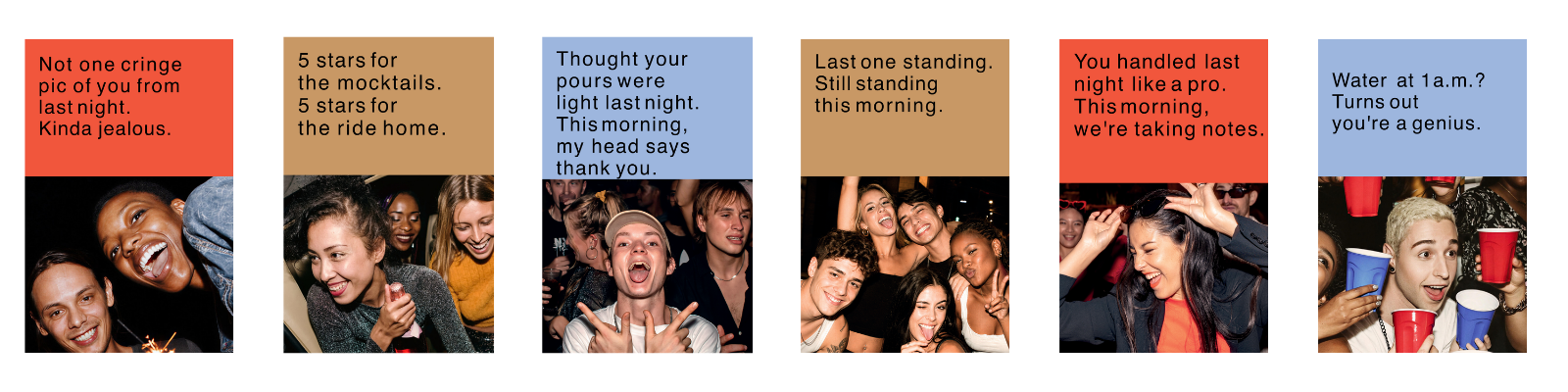
00 - Spacing
When it comes to alcohol, good habits don’t happen by accident
Knowing what’s really in your glass, keeping track of your pace, switching it up at the right time, understanding how drinking affects your behaviour and knowing your limits: these are the skills that help you stay in control, look out for your crew and enjoy the night to the fullest.
00 - Spacing
Enjoy. Choose. Reduce the risks.
00 - Spacing
Three choices. All equally valid.

Your level of risk depends on the situation
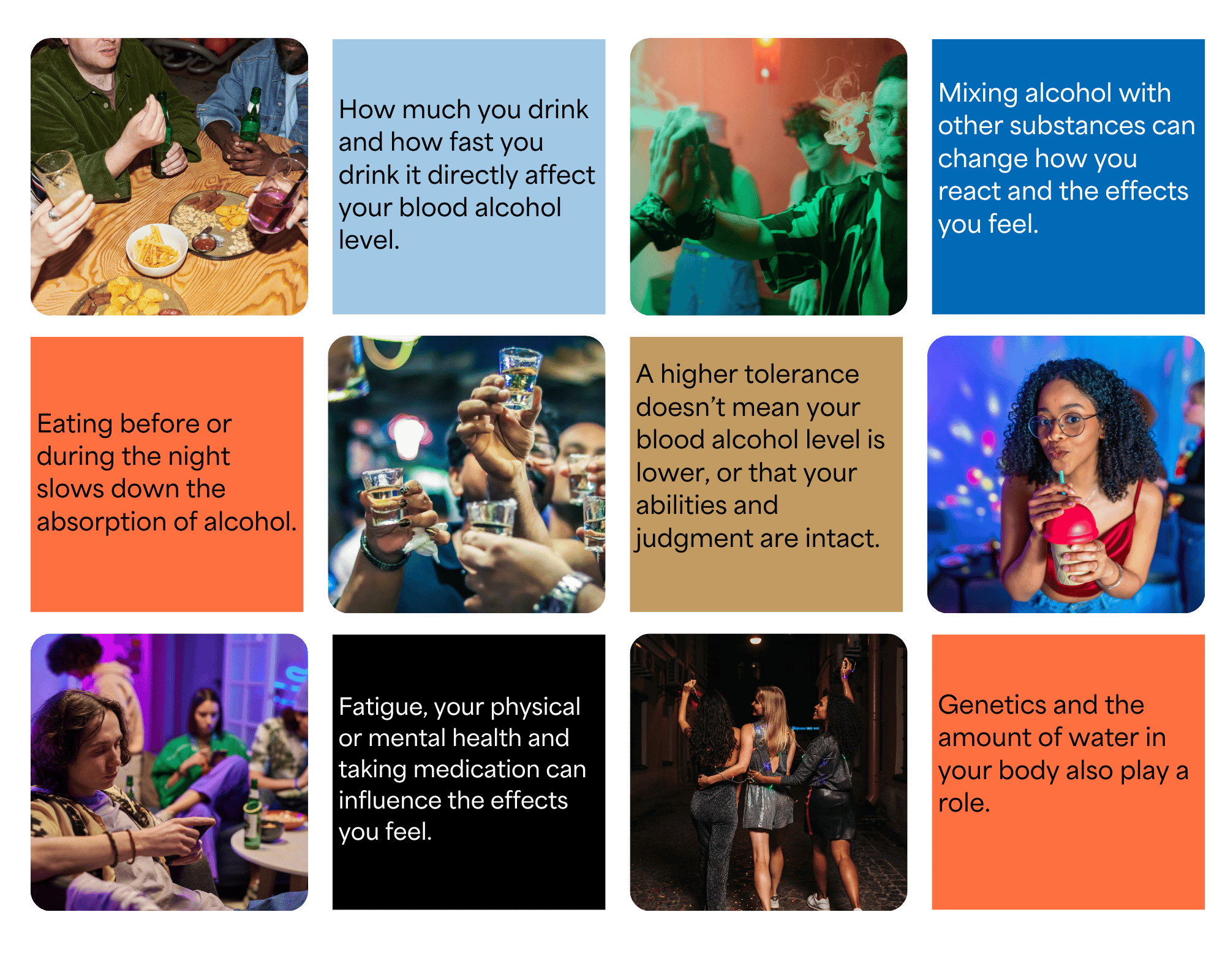
The risks of drinking aren’t just about your blood alcohol level. They also depend on the context, how you're feeling and what's going on around you. Depending on the situation, alcohol can affect your health, increase the risk of accidents or influence how you act: making a decision you wouldn't normally make, underestimating a danger or going past your limits. Understanding what makes that risk go up or down is a smart move to enjoy your night and look out for your crew.
07 - CTA
SMART MOVES
- Don’t compare yourself to others or to what they're drinking ;
- Listen to how your body reacts ;
- Use more neutral benchmarks, like the number of standard drinks and how much time has passed ;
- Pay attention to the signals your body is sending you.
00 - Spacing
Your night in three stages
00 - Spacing
14 - Cards
1. Before: head out with a plan
- Eat before you go out ;
- Decide what you want to drink tonight and set yourself a limit ;
- Check whether your medications can interact with alcohol ;
- Plan your ride home with someone you trust who isn’t drinking ;
- Have a line ready to back up your choice: "No thanks, I'm good." "I'm not drinking tonight." "Want to head home together after?".
2. During: keep a steady pace
- Drink slowly ;
- Count your standard drinks with the Calcoholator ;
- Alternate with non-alcoholic drinks ;
- Watch out for mixed drinks and rounds of shots: they can make you lose count fast.
3. After: end the night safely
- Don’t get behind the wheel (or the handlebars!) after drinking ;
- Head home with someone and take public transit ;
- Never leave a very intoxicated person alone. We look out for each other !
00 - Spacing
Tools to help you stay on track
00 - Spacing
The standard drink under the microscope
Setting yourself a limit before going out? Good call. That’s actually what Health Canada recommends to reduce the risks. But to stick to your limit, you need to know what you're counting. A beer, a glass of wine and a shot don't seem to have much in common at first glance. Yet they may can contain the same amount of pure alcohol: that's what we call a standard drink.
Heads up: with a strong beer, a glass filled to the brim or a sweet cocktail that hides the taste of alcohol, your "one drink" can easily count as two.

00 - Spacing
07 - CTA
GOOD TO KNOW
-
Eating slows down absorption ;
-
Water keeps you hydrated ;
-
Only time lowers your blood alcohol level.
00 - Spacing
Pouring your drinks with the Standard Drink Pourer is already a great habit: you know exactly what’s in your glass, and counting your drinks gets a lot easier. Éduc'alcool's Calcoholator then takes over to help you keep track.
How it works
- Enter some basic info (like your weight) so the calculation is adapted to your metabolism.
- Add each drink you have by selecting the type of alcohol, the volume, the alcohol percentage and the time you had it.
The tool estimates your blood alcohol level to help you make informed choices and enjoy your night safely.
07 - CTA
KEY TAKEAWAY
In Quebec, the zero-alcohol rule applies to all drivers under 22 and to probationary licence holders, regardless of age.
Whatever your age or licence type, Éduc’alcool recommends not driving after drinking alcohol.
00 - Spacing
Recognize the warning signs
00 - Spacing

Do you know what these actually are:
-
• Alcohol poisoning ?
-
• Good Samaritan protection ?
The right moves are learned before an emergency. Find them in Éduc'alcool Q&A.
00 - Spacing
Emergency: do you know what to do ?
14 - Cards
Warning signs
• The person barely responds or doesn’t respond at all
• They’ve passed out
• Their breathing is slow or laboured
• They’re vomiting repeatedly
• Their pulse is weak
• Their skin is cold or clammy
What to do ?
1. I call 911
2. I put them on their side (recovery position)
3. I stay with them
4. I say exactly what they took
Careful: don’t make them throw up. No coffee. No cold shower.
Need help ?
The right numbers at the right time!
8-1-1 — Info-Santé (healthinfo line)
9-1-1 — Emegency
Alcohol, Drugs: Help and Referral: 24/7 — free and confidential | 514-527-2626 or 1-800-265-2626
Sexual Violence Helpline: 1-888-933-9007
00 - Spacing
Drinking is never consent

00 - Spacing
No matter the context or how much alcohol was consumed, consent must be freely given, clear, explicit and verifiable.
A person who is unconscious or unable to clearly express agreement cannot consent. If it’s not a clear yes, stop.
00 - Spacing
LEARN MORE
To assess a situation, step in as a bystander or respond when someone is intoxicated, check out these resources:
00 - Spacing
What the science says: some references articles.
Revue de presse Éduc'alcool
Les Affaires
Une description de la ressource partagée. Juste quelques phrases devraient être parfaites.
Lire l'articleLe Devoir
Une description de la ressource partagée. Juste quelques phrases devraient être parfaites.
Lire l'articleRadio-Canada
Une description de la ressource partagée. Juste quelques phrases devraient être parfaites.
Lire l'articleLes coop de l'information
Une description de la ressource partagée. Juste quelques phrases devraient être parfaites.
Lire l'articleCBC - Anglais
Une description de la ressource partagée. Juste quelques phrases devraient être parfaites.
Lire l'articleThe Gazette - anglais
Une description de la ressource partagée. Juste quelques phrases devraient être parfaites.
Lire l'article
00 - Spacing
Does Gen Z really drink less?
Éduc'alcool · 18 août 2026
This summer, the same headline was everywhere: Gen Z sobriety is a myth. The number behind it? 74% of young adults drank alcohol in the past six months, compared with 76% of all adults. Case closed, right?
But the data here tell a different story. So, myth or reality? In this article, Éduc’alcool breaks down the numbers and gives you four simple tips so you don't get fooled by headlines about alcohol.
00 - Buttons
On campus, alcohol is part of social life.
Association pour la santé publique du Québec · March 29, 2022
Based on a Léger survey conducted for the Association pour la santé publique du Québec (ASPQ) among Quebecers, including a sample of 307 full-time students, this report on alcohol consumption highlights some unique aspects of students’ relationship with alcohol.
While 88% of students say they have drunk alcohol, compared with 92% of the general population, a larger share of them link drinking to socializing (14% vs. 8%) or to the influence of the people around them (14% vs. 5%).
Social activities are also more often a setting for heavy drinking among students (84% vs. 68%), which shows how much their social environment shapes their habits.
00 - Buttons
Are prior-day stress severity and stressor-related guilt associated with next-day alcohol use in college students?
Courtney et coll. · January 31, 2024
This intensive longitudinal study followed 58 college students aged 18 to 25 who engaged in binge drinking at least twice monthly and had used cannabis or tobacco in the past year. Over 11 days, participants wore activity and alcohol monitors and completed daily surveys assessing prior-day stressor frequency, stress severity and stressor-related affective states, including guilt and anger. The researchers examined associations between these prior-day stress processes and current-day alcohol use.
Greater-than-usual prior-day stress severity was associated with higher odds of current-day drinking (OR = 1.21) and greater area under the transdermal alcohol concentration curve (AUC). More frequent prior-day stressor-related guilt was associated with higher current-day peak transdermal alcohol concentration and greater AUC. Guilt and anger were assessed as stressor-related affective states, not as stressors themselves.
These findings are consistent with a negative reinforcement account of alcohol use, but the observed associations do not establish causation or show that participants drank specifically to relieve distress. The authors emphasize the need for interventions that help college students manage and respond to daily stress.
00 - Buttons
00 - Spacing

Nos coordonnées
Éduc'alcool
606 rue Cathcart · bureau 315
Montréal, Québec · H3B 1K9
info@educalcool.qc.ca